
Meet the Multiverses
Three distinct ideas of a multiverse appear in physics. What do they mean?

Let’s be honest: the moment you heard “multiverse,” you pictured Doctor Strange punching through mirror dimensions while Spidermen from different timelines pointed fingers at each other. Multiverse is the one physics idea that broke confinement and exploded into popular consciousness.
But if you only know of the multiverse from Marvel movies, it will come as a surprise that there isn’t just one multiverse in physics. When physicists speak of the multiverse, they might be talking about one of three completely different concepts.
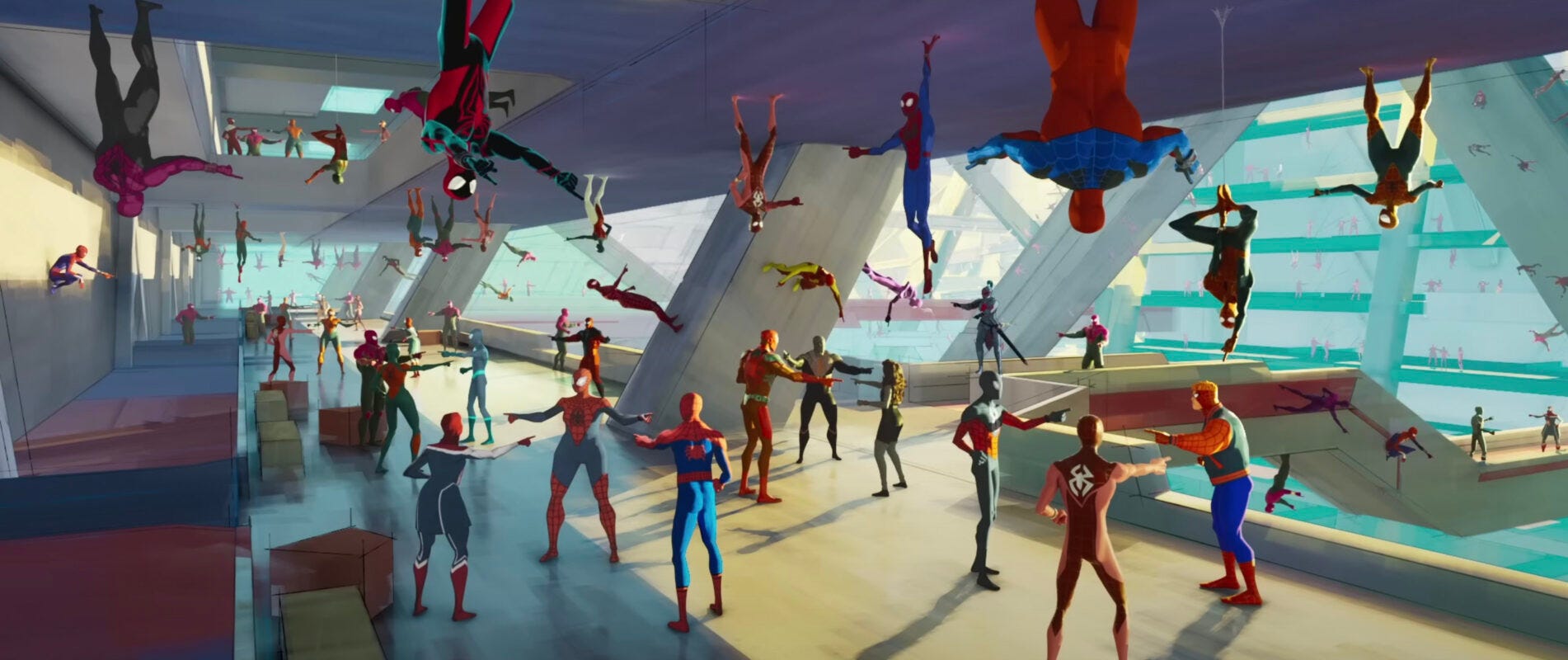
Let’s meet the Multiverses.
The Quantum Multiverse
Quantum Mechanics is notoriously cagey. It refuses to give definite answers till a measurement is made. Before you make your observation, be it on a radioactive atom, a spinning electron or Schrödinger’s cat, nature exists in a superposition of possible outcomes. The Cat is both dead and alive.
When you make your measurement, you get only one outcome. The cat either comes out purring, or it has joined the choir invisible and become an ex-cat. The orthodox interpretation of quantum mechanics says that the superposition collapses into a single state—the one we observe. But what if it did not?
In 1957, physicist Hugh Everett III1 came up with a brilliant new way of looking at quantum mechanics. He proposed that superpositions don’t collapse, they just pull the observers themselves into the superposition. After Schrödinger opens the box to check on his cat, reality continues to exist in a superposition of the two outcomes: one with Schrödinger playing with his cat and the other with Schrödinger writing its obit.
Everett’s radical unorthodoxy led to what is now known as the Many Worlds Interpretation (MWI). In this interpretation, observations do not choose a possibility out of many. The wavefunction never collapses; it just proliferates into multiple branches. It’s the ultimate choose-your-adventure show where every possible ending happens simultaneously.
When movies and shows imagine forking timelines and infinite doppelgängers, it is the MWI that they are inspired by. Where fiction differs from fact: it is impossible to detect the other branches, much less go on adventures with your multiversal counterparts. After all, the MWI is an interpretation of quantum mechanics, not a separate theory with its own predictions.
The Cosmic Multiverse
This version of the multiverse has nothing to do with infinite copies of you, and everything to do with the infancy of the universe. The theory of inflation suggests that the infant universe had a growth spurt to end all growth spurts: stretching space flat like a pancake. But here’s the kicker: inflation might not have stopped everywhere at once.
As per a large class of inflationary models, inflation is eternal once it starts. Quantum jitters keep it rolling in some patches, creating a never-ending churn of “bubble universes.” Self-contained cosmoses with their own cosmic histories, bubble universes are separated by horizons across which no light can ever pass. Our visible universe would be just one bubble in this infinite champagne.
The cosmic multiverse is neither an interpretation of a known theory nor fanciful speculation, it arises naturally from many versions of inflation. And while inflation remains to be proven beyond reasonable doubt, it is still the theory that best explains our cosmological observations.
If the prevailing models of inflation get it right, the cosmic multiverse is very likely real. But just like in the quantum multiverse although for totally different reasons, it is impossible to detect the existence of our cousin universes2.
The String Multiverse
If the cosmic multiverse expands space itself, the string multiverse multiplies the possible laws that govern it.
String theory is the leading candidate for a Theory of Everything: the fundamental theory that unifies all interactions. In the early days of string theory, it was expected that our observable universe would pop out of the equations of string theory. That expectation hit a hitch when it was discovered that the theory’s equations admit an enormous number of stable configurations.
Each corresponds to a different way of curling up extra dimensions and threading them with fields, leading to different effective laws of physics. Each could embody a distinct set of physical constants. Gravity might be stronger in one, electromagnetism weaker in another.
This is the string landscape. While the recent Swampland program has been pruning the landscape out of candidates that don’t fit with quantum gravity, it is still an unreasonably large number.
Combining the string landscape with eternal inflation introduces a new twist: cosmic vacuum bubbles that each stabilize into a different string vacuum. In this picture, the multiverse becomes populated with regions that realize distinct string vacua—each with its own physical laws, constants, and particles. That’s the string landscape multiverse.
---
Three concepts, all with the moniker “multiverse.” The first multiplies outcomes, the second space, the third laws. Together, they hint that reality may be far larger and stranger than the universe we see.
My suggestion for the title of an Everett biopic: “Everett-ing Everywhere All At Once”
Except possibly via quantum tunneling between vacua, which is a story for another time.